Navy Burial at Sea for Veterans: Eligibility, Paperwork and What to Expect
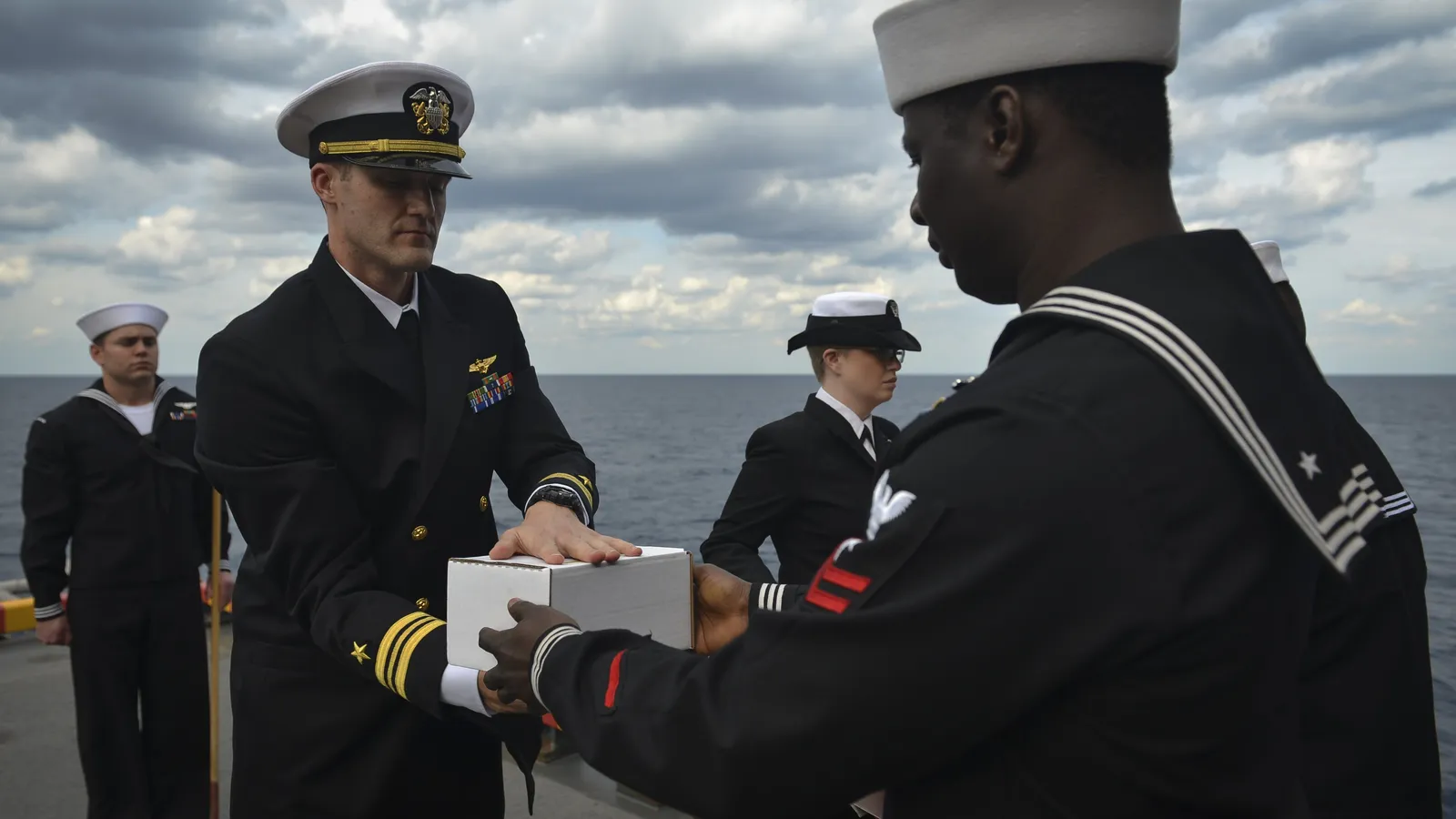
The U.S. Navy offers burial at sea to veterans, retirees and their dependents, committed from a Navy ship by its crew. It is a meaningful choice, but it works differently from a private scattering: the family doesn’t go aboard, and it can take a year or more. Here is who qualifies, what to send, and how to plan around it.
By The Memorial Market Editorial Team · Updated · 8 min read

Quick answer
The U.S. Navy’s burial at sea program commits the remains of eligible people from a Navy ship while it is deployed. Eligible: active-duty members, retirees, honorably discharged veterans, Military Sealift Command civilian marine personnel, and dependents of active-duty members, retirees and veterans. Family cannot attend; afterward, the commanding officer sends the date, time and coordinates. The Navy says the average wait is 12 to 18 months after the remains reach the port. Call 1-833-330-6622, then send the forms, death certificate, permit and DD-214 with the remains to one of five ports. Caskets are accepted only at Norfolk and San Diego.
Key facts
- Eligible: active duty, retirees, honorably discharged veterans, MSC civilian marine personnel, and dependents.
- The committal happens while the ship is deployed; families do not attend.
- Average wait: 12 to 18 months after the remains arrive at the port.
- Ports: Norfolk, Jacksonville, San Diego, Bremerton and Honolulu; caskets only at Norfolk and San Diego.
- Cremated remains go by Priority Mail Express in a spun-brass or biodegradable urn, never plastic.
- A burial flag is required and is returned to the primary next of kin; the VA can provide an “In Memory Of” marker.
Who is eligible for a Navy burial at sea?
The program is run by the Navy, not by the VA’s National Cemetery Administration (VA). The Navy lists these people as eligible (MyNavy HR):
- Active-duty members of the uniformed services.
- Retirees and veterans who were honorably discharged.
- U.S. civilian marine personnel of Military Sealift Command.
- Dependent family members of active-duty personnel, retirees and veterans of the uniformed services.
The U.S. Coast Guard also performs burials at sea, and the Massachusetts Department of Public Health notes that it accepts cremated remains only, while the Navy accepts both cremated and casketed remains (Mass. DPH).
How to request a Navy burial at sea
Call the program
Start with the Navy’s burial at sea line, 1-833-330-6622, or the coordinator at the port you’ll use (MyNavy HR).
Complete the request
Fill out the Navy’s burial at sea request forms (OPNAV 5360 series) from the program page.
Gather the documents
A copy of the death certificate, the burial transit permit or cremation certificate, and the veteran’s DD-214 or other discharge papers showing eligibility.
Request the burial flag
A U.S. burial flag is required for the committal. Request one with VA Form 27-2008 at a post office or VA office; it is returned to the primary next of kin afterward.
Send the remains
Ship cremated remains to the port by USPS Priority Mail Express (the only legal way to mail cremated remains), in a spun-brass or biodegradable urn with no plastic. For a casket, your funeral home arranges transport to Norfolk or San Diego.
Wait for the certificate
After the committal, the ship’s commanding officer sends the family a letter with the date, time, latitude and longitude, and the flag.
The five Navy ports of embarkation
| Port | Coordinator | Accepts |
|---|---|---|
| Norfolk, Virginia | Decedent Affairs, Naval Medical Center Portsmouth, (757) 953-2777 | Cremated and casketed remains |
| Jacksonville, Florida | Naval Station Mayport branch health clinic, (904) 270-4214 | Cremated remains |
| San Diego, California | Decedent Affairs, Naval Medical Center San Diego, (619) 532-8305 | Cremated and casketed remains |
| Bremerton, Washington | Naval Hospital Bremerton, (360) 475-4777 | Cremated remains |
| Honolulu, Hawaii | Navy liaison at Tripler Army Medical Center (email preferred) | Cremated remains |
Contacts from the Navy’s program page; confirm before shipping (MyNavy HR).
Casketed burials need a casket prepared to sink, and the person directing disposition pays for the casket preparation and transport to the port. Your funeral director will coordinate this with Norfolk or San Diego.
A memorial marker for a veteran buried at sea
A burial at sea leaves no grave to visit, but the VA provides memorial headstones and markers for eligible veterans whose remains were buried at sea or scattered. The inscription must begin “IN MEMORY OF,” and you apply with VA Form 40-1330 (VA headstone FAQs). A national cemetery memorial section or a family plot can give relatives a place to visit.
Frequently asked questions
Who is eligible for a Navy burial at sea?
Active-duty members, retirees, honorably discharged veterans, Military Sealift Command civilian marine personnel, and dependents of active-duty members, retirees and veterans.
Can the family attend a Navy burial at sea?
No. The committal happens while the ship is deployed. The commanding officer sends the family the date, time and coordinates afterward.
How long does a Navy burial at sea take?
The Navy says the average wait is 12 to 18 months after the remains reach the port of embarkation.
Does the Navy accept caskets for burial at sea?
Yes, but only at Norfolk and San Diego. The person directing disposition pays for casket preparation and transport.
What documents do I need for a Navy burial at sea?
The Navy request forms, a copy of the death certificate, the burial transit permit or cremation certificate, the DD-214 or discharge papers, and a burial flag.
How do I mail ashes to the Navy?
By USPS Priority Mail Express, in a spun-brass or biodegradable urn without plastic, addressed to the port coordinator.
Does the Coast Guard do burials at sea?
Yes, for cremated remains only, according to the Massachusetts Department of Public Health. The Navy accepts cremated and casketed remains.
Can a veteran buried at sea get a headstone?
The VA provides memorial headstones and markers for eligible veterans whose remains were buried at sea. The inscription begins “IN MEMORY OF”; apply with VA Form 40-1330.
General information, not legal advice. Laws and agency policies change; confirm with the agency, landowner or your provider before you go.
Sources
Every rule and price range above comes from these pages, checked November 17, 2026.